


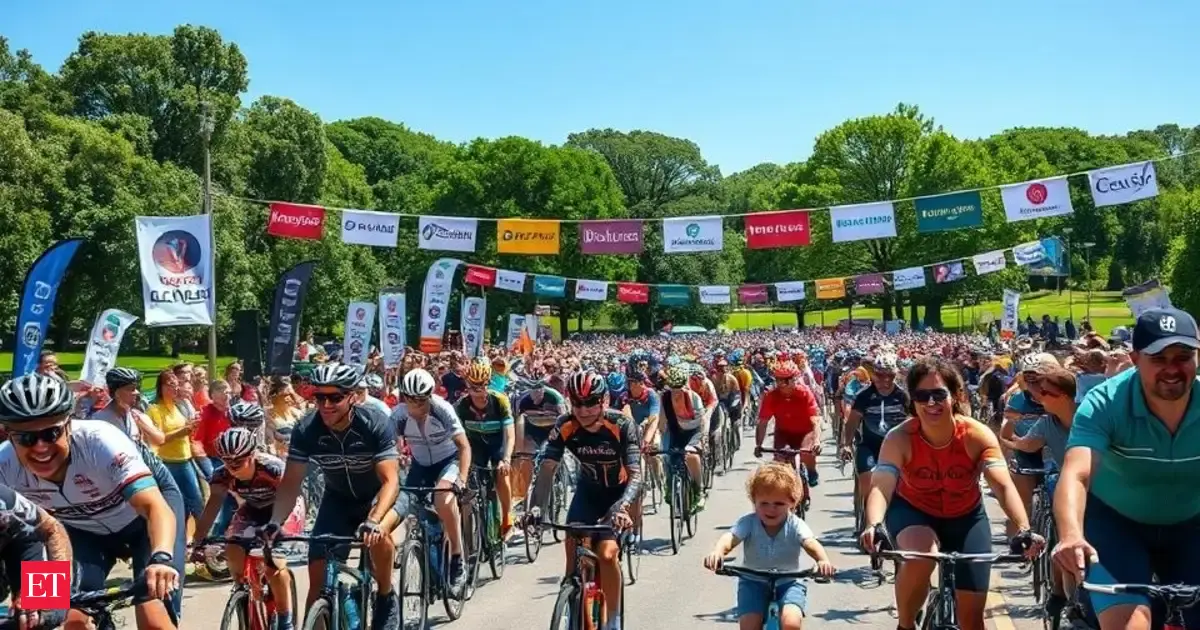
These formats are gaining traction as more people focus on fitness and community-driven activities. The Mumbai Marathon, the country’s leading participative sports property, is a World Athletics Gold Label Race and remains a benchmark for mass participation events in India.
Participatory sports differ from spectator sports such as cricket and football, as individuals actively engage in physical activity rather than merely watching it.
Corporate houses are increasingly spotting opportunities in this space. JSW Sports and Adani Sportsline are evaluating new mass participation formats. Adani Sportsline already organises the Ahmedabad Marathon, which is sanctioned by the Athletics Federation of India.
According to a KPMG report, participative sports events such as marathons in Mumbai, Delhi and Bengaluru, cycling races, corporate tournaments and society leagues significantly boost local businesses, including hotels, food and transport, while also driving the fitness and wellness economy. Marathons alone contribute ₹250-300 crore annually. More than 1,500 marathons are held in India, with registrations ranging from 5,000 to 65,000 participants, it noted.


Live Events
Vivek Singh, joint managing director at Procam International, which organises four running events including those in Mumbai, Delhi and Kolkata, said India’s participative sports ecosystem is valued at around ₹4,000 crore. Sponsorship accounts for nearly 20% of this, while the remaining 80% comes from allied segments such as nutrition, training programmes, coaching, subscription-based fitness platforms, equipment, footwear and apparel.
The country has around 2.8 million runners, with nearly 1,000 new participants joining every day, he added.”This means the sport is growing by over 365,000 runners annually, making it the fastest-growing sport in the country. No other sport in India is expanding at this rate. If this base grows from 2.8 million to 5 million, or even ten million runners, the ecosystem value will multiply significantly. What we are seeing today is only the tip of the iceberg,” Singh said.
A typical runner standing at a marathon start line is wearing between ₹50,000 and ₹1 lakh worth of equipment, including running shoes that can cost ₹15,000-18,000, performance apparel, smart watches, fitness apps and accessories. “This clearly shows how significant the running economy has become,” he added.
Adani Sportsline chief business officer Sanjay Adesara said the company is actively evaluating opportunities in the participative sports ecosystem. “We are not only sponsoring the Ahmedabad Marathon, but also organising it at the ground level. Ahmedabad is India’s fifth largest marathon with 25,000-plus runners,” he said.
The Adani Group’s sports arm is also aiming to grow international participation. “Post-Covid, health and fitness is on the rise. If you see not only running, cycling, all such sports are seeing that uplift. Even events like Ironman and such things are also seeing a huge rise,” Adesara said.
The participative sports ecosystem will see a significant uplift as India’s per capita income rises, fuelling investments in leisure activities, fitness and community-led initiatives, he said.
However, not all participative formats scale equally.
Melroy D’Souza, chief operating officer at PMG Sports, a joint venture of Sunil Gavaskar, Sam Balsara and Noomi Mehta, said marathons, padel, turf football and pickleball have all seen strong growth, but remain niche and largely attract deeply committed enthusiasts.
“Most such events rely heavily on sponsorships and participation fees, as they are not primarily designed for television or streaming audiences. As a result, only marquee events are performing well, while many smaller tournaments struggle to remain viable and are gradually dropping out,” he said. “Participative sports also offer tourism potential, but realising this opportunity depends significantly on the level of involvement and support from local authorities.”
Pune has seen the launch of the Pune Grand Tour multistage road race, with cricketer MS Dhoni as its brand ambassador. The event will be held from January 19 to 23 and is being organised by the Pune Municipal Corporation and Pimpri-Chinchwad Municipal Corporation with backing from the Bajaj Group.
Pune district collector Jitendra Dudi said cycling in India is at the same inflection point that marathon running was a decade ago.
“For cycling events to match that level of commercial maturity, sponsorship must move beyond visibility into deeper partnerships, where brands invest in the longer vision of the sport, athlete development, fan experiences, sustainability and city engagement, not just race-day branding,” he said. “We need safer, well-managed routes and structured participation formats that make cycling a habit rather than a one-off activity.”
link