Baby and Infant Packaged Food Market Forecast and Outlook 2025 to 2035
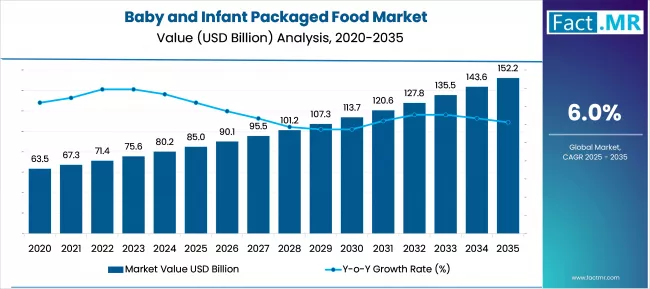
The global baby and infant packaged food market is projected to grow from USD 85.0 billion in 2025 to approximately USD 152.2 billion by 2035, recording an absolute increase of USD 79.5 billion over the forecast period. This translates into a total growth of 93.5%, with the market forecast to expand at a compound annual growth rate (CAGR) of 6.0% between 2025 and 2035. The overall market size is expected to grow by nearly 1.94X during the same period, supported by increasing birth rates in developing countries, rising parental awareness about infant nutrition, and growing focus on premium and organic baby food products.
Quick Stats for Baby and Infant Packaged Food Market
- Baby and Infant Packaged Food Market Value (2025): USD 85.0 billion
- Baby and Infant Packaged Food Market Forecast Value (2035): USD 152.2 billion
- Baby and Infant Packaged Food Market Forecast CAGR: 6.0%
- Leading Product Type in Baby and Infant Packaged Food Market: Infant Formula (52.0%)
- Key Growth Regions in Baby and Infant Packaged Food Market: North America, Europe, and Asia Pacific
- Top Key Players in Baby and Infant Packaged Food Market: Nestlé, Danone, Abbott Laboratories, Mead Johnson, Reckitt Benckiser, Hero Group, Perrigo Company, Hipp GmbH, Bellamy’s Organic
Between 2025 and 2030, the baby and infant packaged food market is projected to expand from USD 85.0 billion to USD 113.8 billion, resulting in a value increase of USD 28.8 billion, which represents 36.2% of the total forecast growth for the decade. This phase of growth will be shaped by rising disposable income in emerging markets, increasing working mothers population, and growing penetration of premium organic baby food products in developed economies. Baby food manufacturers are expanding their nutritional product portfolios to address the growing demand for specialized infant nutrition solutions.
Baby and Infant Packaged Food Market Key Takeaways
| Metric | Value |
|---|---|
| Estimated Value in (2025E) | USD 85.0 billion |
| Forecast Value in (2035F) | USD 152.2 billion |
| Forecast CAGR (2025 to 2035) | 6.0% |
From 2030 to 2035, the market is forecast to grow from USD 113.8 billion to USD 152.2 billion, adding another USD 50.7 billion, which constitutes 63.8% of the overall ten-year expansion. This period is expected to be characterized by expansion of e-commerce and direct-to-consumer channels, integration of advanced nutritional research in product formulations, and development of personalized baby nutrition solutions. The growing adoption of organic and clean-label trends and pediatrician-recommended products will drive demand for premium baby and infant packaged foods with enhanced nutritional profiles and safety standards.
Between 2020 and 2025, the baby and infant packaged food market experienced steady expansion, driven by increasing parental awareness about early childhood nutrition and growing demand for convenient feeding solutions. The market developed as parents recognized the importance of balanced nutrition during critical growth periods. Healthcare professional recommendations and nutritional research began emphasizing the significance of quality ingredients and age-appropriate formulations in supporting healthy infant development and immune system building.
Why the Baby and Infant Packaged Food Market is Growing?
Market expansion is being supported by the increasing parental awareness about the importance of proper nutrition during the first years of life and the corresponding demand for scientifically-formulated baby food products. Modern parents are increasingly focused on providing optimal nutrition that supports cognitive development, immune system strengthening, and healthy physical growth. Baby and infant packaged foods’ proven benefits in delivering balanced nutrition, convenience, and safety make them essential components of modern childcare practices.
The growing number of working mothers and dual-income households is driving demand for convenient, ready-to-feed baby food solutions that save time while ensuring nutritional adequacy. Consumer preference for premium, organic, and clean-label products that are free from artificial additives, preservatives, and pesticides is creating opportunities for innovative formulations. The rising influence of pediatrician recommendations, parenting blogs, and social media communities is also contributing to increased product adoption across different demographic segments and income levels.
Segmental Analysis
The market is segmented by product type, distribution channel, age group, packaging type, ingredient source, and region. By product type, the market is divided into infant formula, baby cereals, baby snacks, baby purees, jarred food, and others. Based on distribution channel, the market is categorized into supermarkets, online retail, pharmacies & drug stores, specialty baby stores, and others. In terms of age group, the market is segmented into 0-6 months, 6-12 months, and 12-36 months. By packaging type, the market is classified into cans/tins, jars, pouches, boxes, and others. By ingredient source, the market is divided into organic, conventional, and fortified. Regionally, the market is divided into North America, Europe, Asia Pacific, Latin America, and Middle East & Africa.
By Product Type, Infant Formula Segment Accounts for 52.0% Market Share
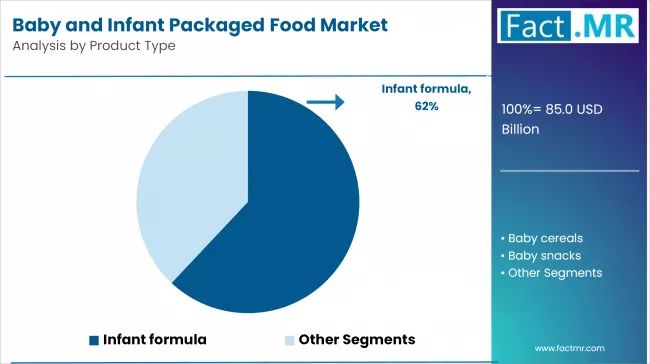
The infant formula segment is projected to account for 52.0% of the baby and infant packaged food market in 2025, reaffirming its position as the category’s dominant product type. Parents increasingly rely on scientifically-formulated infant formula as a breast milk substitute or supplement, particularly in situations where breastfeeding is not possible or sufficient. Modern infant formulas contain essential nutrients, vitamins, minerals, and prebiotics that support healthy growth and development during the critical first months of life.
This segment forms the foundation of the baby food industry, as it addresses the most fundamental nutritional needs of infants from birth to 12 months. Pediatrician recommendations and ongoing nutritional research continue to drive innovation in formula compositions, including specialized formulations for premature babies, allergic infants, and specific dietary requirements. With increasing numbers of working mothers and growing acceptance of formula feeding, infant formula maintains its market leadership position, making it the primary revenue driver in the baby and infant packaged food market.
By Distribution Channel, Supermarkets Segment Accounts for 45.0% Market Share
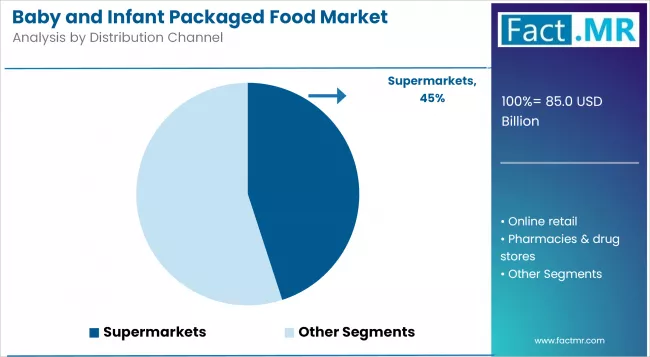
Supermarkets are projected to represent 45.0% of baby and infant packaged food demand in 2025, underscoring their role as the primary distribution channel for accessible baby nutrition products. Parents prefer supermarkets for their convenience, wide product selection, competitive pricing, and ability to combine baby food shopping with regular grocery purchases. These large-format retail outlets offer comprehensive baby food sections, trusted brands, and often provide pharmacist consultations for infant nutrition questions.
The segment is supported by supermarkets’ strategic placement of baby food products in easily accessible locations, promotional pricing strategies, and integration with loyalty programs that appeal to cost-conscious parents. Additionally, many supermarket chains have developed private-label baby food lines that offer quality products at competitive prices. As baby food becomes more mainstream and parents seek convenient shopping solutions, supermarkets continue to dominate market access, reinforcing their critical role in the baby and infant packaged food distribution ecosystem.
By Geography, North America Segment Accounts for 33.0% Market Share
The North America region is forecasted to contribute 33.0% of the baby and infant packaged food market in 2025, reflecting the region’s leadership in infant nutrition awareness and regulatory standards for baby food safety. The United States and Canada have established stringent food safety regulations, comprehensive pediatric nutrition guidelines, and strong consumer acceptance of premium baby food products. High disposable income and health-conscious parenting culture further strengthen the regional market position.
The segment benefits from advanced healthcare systems, widespread pediatrician recommendations, and well-developed retail distribution networks that facilitate baby food accessibility across diverse geographic areas. North American parents demonstrate willingness to invest in premium, organic, and specialized baby food products that align with their values regarding child health, nutrition, and development. With continued emphasis on early childhood nutrition and safety standards, North America serves as both a major consumer market and innovation hub, making it a critical driver of global baby and infant packaged food demand and product development.
What are the Drivers, Restraints, and Key Trends of the Baby and Infant Packaged Food Market?
The baby and infant packaged food market is advancing steadily due to increasing parental awareness about infant nutrition and growing demand for convenient, safe, and nutritionally-complete feeding solutions. However, the market faces challenges including stringent regulatory requirements, concerns about processed foods, and competition from breastfeeding advocacy. Innovation in organic formulations and personalized nutrition solutions continue to influence product development and market expansion patterns.
Expansion of E-commerce and Direct-to-Consumer Channels
The growing adoption of online retail platforms is enabling baby food brands to reach parents directly and provide detailed product information about ingredients, nutritional benefits, and age-appropriate feeding guidelines. E-commerce channels offer convenience, subscription services, and specialized baby product marketplaces that cater to busy parents seeking trusted nutrition solutions. Digital marketing strategies and parenting community engagement are driving brand awareness and product adoption, particularly among millennial parents who prioritize online shopping and value transparency in product information.
Integration of Advanced Nutritional Research and Personalized Solutions
Modern baby food manufacturers are incorporating latest pediatric nutrition research, probiotics, prebiotics, and brain development nutrients to enhance product formulations. These advances improve nutritional value, digestibility, and developmental support while addressing specific dietary needs and health concerns. Personalized nutrition solutions based on individual infant requirements, allergies, and developmental stages are emerging as key differentiators in the premium baby food segment.
Analysis of Baby and Infant Packaged Food Market by Key Country
Europe Market Split by Country
The European baby and infant packaged food market demonstrates sophisticated development across major economies with Germany leading through its stringent quality standards, health-conscious parenting culture, and consumer preference for scientifically-formulated nutrition products that emphasize ingredient transparency, organic certification, and developmental nutrition research. The UK shows significant strength in organic and clean-label products, with British parents increasingly valuing ingredient transparency, allergen management, and evidence-based infant nutrition while driving demand for hypoallergenic and specialized baby food formulations. France exhibits excellence through companies like Danone providing premium organic and conventional baby food ranges with emphasis on natural ingredients and sustainable sourcing practices that align with European quality standards.
Italy and Spain demonstrate growing adoption of premium baby nutrition products, while Nordic countries contribute through sustainable and environmentally-conscious baby food innovations. The market benefits from strict EU regulatory frameworks, established pediatric healthcare systems, and strong consumer focus on product safety and nutritional adequacy, positioning Europe as a key market for premium baby and infant packaged foods requiring superior quality standards, organic certification, and comprehensive safety compliance across diverse infant nutrition applications.
South Korea Market Split by Country
The South Korean baby and infant packaged food market shows emerging growth potential driven by expanding health consciousness, increasing number of working mothers, and growing consumer preference for premium baby nutrition products that support optimal infant development and health outcomes. The market benefits from South Korea’s technological advancement in food processing and increasing focus on quality infant nutrition that aligns with traditional Korean wellness principles while meeting modern convenience requirements. Korean parents increasingly prioritize organic ingredients, clean-label formulations, and scientifically-validated nutritional benefits in baby food selection, driven by rising disposable income and health awareness.
Growing influence of Korean healthcare practices and pediatric nutrition guidelines supports demand for specialized baby food products that address specific developmental needs and dietary requirements. The integration of traditional Korean dietary wisdom with modern infant nutrition science creates opportunities for innovative baby food formulations that combine cultural authenticity with scientific advancement. Rising urbanization and dual-income households drive demand for convenient, nutritionally-complete baby feeding solutions across infant formula, baby cereals, and ready-to-feed products requiring superior quality, safety assurance, and developmental nutrition benefits for both domestic consumption and potential export market expansion.
Analysis of Baby and Infant Packaged Food Market
| Country | CAGR (2025-2035) |
|---|---|
| China | 8.2% |
| India | 7.8% |
| Brazil | 7.1% |
| USA | 5.5% |
| Germany | 5.2% |
| UK | 4.9% |
| Japan | 4.6% |
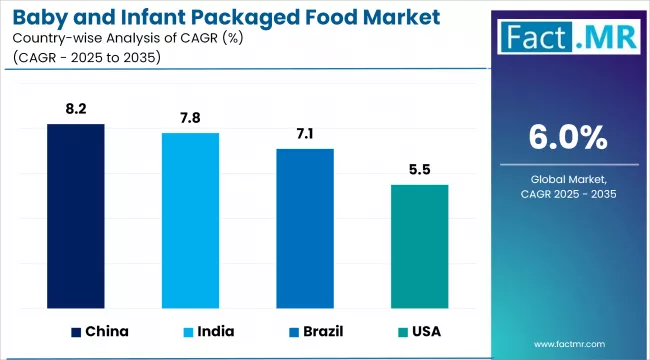
The baby and infant packaged food market is experiencing varied growth globally, with China leading at an 8.2% CAGR through 2035, driven by relaxed population policies, rising middle class income, and increasing urbanization creating demand for convenient baby feeding solutions. India follows at 7.8%, supported by large birth population, improving healthcare awareness, and growing penetration of packaged baby food in urban areas. Brazil shows significant growth at 7.1%, driven by expanding middle class, increasing working mothers, and growing acceptance of commercial baby food products. The USA records 5.5%, emphasizing premium and organic product segments. Germany demonstrates 5.2% growth, focusing on high-quality and scientifically-formulated products. The UK shows 4.9% growth with emphasis on organic and clean-label baby foods.
The report covers an in-depth analysis of 40+ countries; seven top-performing countries are highlighted below.
China Leads Asian Market Growth with Urban Development
Revenue from baby and infant packaged food in China is projected to exhibit strong growth with a CAGR of 8.2% through 2035, driven by relaxed population policies, rapid urbanization, and increasing number of working mothers seeking convenient feeding solutions. The country’s expanding middle class and growing awareness of infant nutrition importance create significant opportunities for both domestic and international baby food manufacturers across tier-1 and tier-2 cities.
- Government support for maternal and child health initiatives is driving demand for nutritionally-adequate baby food products throughout major urban centers and developing rural areas.
- E-commerce platform expansion and digital payment adoption are supporting rapid product accessibility and consumer education about infant nutrition benefits and feeding guidelines.
India Demonstrates High Growth Potential with Large Birth Population
Revenue from baby and infant packaged food in India is expanding at a CAGR of 7.8%, supported by large birth population, increasing healthcare awareness, and rising disposable income among urban families. The country’s growing middle class and expanding retail infrastructure create favorable conditions for packaged baby food adoption, particularly in metropolitan areas where convenience and nutrition quality are increasingly valued by parents.
- Rising awareness about infant nutrition and developmental milestones is creating opportunities for specialized baby food products across urban and semi-urban markets throughout major states.
- Growing penetration of organized retail and pharmacy chains is improving product accessibility and consumer trust in branded baby food products among health-conscious parents.
Brazil Shows Strong Emerging Market Growth
Demand for baby and infant packaged food in Brazil is projected to grow at a CAGR of 7.1%, supported by expanding middle class, increasing women workforce participation, and growing acceptance of commercial baby food as nutrition supplements. Brazilian parents are increasingly focused on product quality, safety, and convenience, creating significant opportunities for premium baby food brands in both domestic and international markets.
- Government healthcare programs and pediatric nutrition guidelines are supporting consumer education about infant feeding practices and nutritional requirements during critical growth periods.
- Expanding retail distribution networks and improving economic conditions are facilitating baby food accessibility across diverse geographic regions and income segments.
United States Maintains Premium Market Leadership
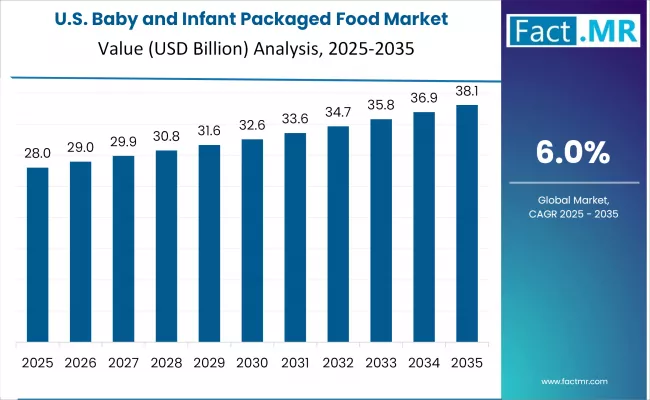
Revenue from baby and infant packaged food in the USA is projected to grow at a CAGR of 5.5% through 2035, driven by consumer preference for premium, organic, and specialized baby food products that support optimal infant development. American parents consistently prioritize product quality, safety certifications, and nutritional adequacy, positioning the market toward high-value segments with advanced formulations and clean-label positioning.
- Rising demand for organic, non-GMO, and allergen-free baby food products is driving innovation in natural ingredient sourcing and advanced processing technologies throughout the supply chain.
- Strong regulatory framework and pediatrician recommendations are supporting consumer confidence in branded baby food products while encouraging continuous product improvement and safety standards.
Germany Strengthens European Market with Quality Standards
Revenue from baby and infant packaged food in Germany is projected to grow at a CAGR of 5.2% through 2035, supported by stringent quality standards, health-conscious parenting culture, and consumer preference for scientifically-formulated nutrition products. German parents value ingredient transparency, organic certification, and developmental nutrition research, positioning premium baby food as essential components of infant care routines.
- EU regulatory compliance and German quality standards are driving manufacturers to adopt sustainable sourcing practices and rigorous testing protocols for baby food products.
- Growing emphasis on environmental sustainability and ethical sourcing is encouraging brands to develop eco-friendly packaging and organic ingredient formulations that appeal to environmentally-conscious parents.
United Kingdom Focuses on Organic and Clean-Label Products
Revenue from baby and infant packaged food in the UK is projected to grow at a CAGR of 4.9% through 2035, supported by rising consumer interest in organic, clean-label baby food products and evidence-based infant nutrition. British parents increasingly value ingredient transparency, allergen management, and developmental nutrition science, positioning premium baby food brands as trusted partners in early childhood development.
- Growth in online retail and subscription services is increasing accessibility of specialized baby food products across diverse consumer demographics and geographic regions throughout the UK.
- Rising awareness about food allergies and dietary sensitivities is driving demand for hypoallergenic and specialized baby food formulations that address individual infant health requirements.
Japan Maintains Innovation Leadership with Advanced Formulations
Revenue from baby and infant packaged food in Japan is projected to grow at a CAGR of 4.6% through 2035, supported by the country’s focus on product innovation, premium positioning, and scientific approach to infant nutrition. Japanese parents consistently demand high-quality, functionally-enhanced baby food products that incorporate latest nutritional research and traditional dietary wisdom.
- Ongoing investment in nutritional research and product development is supporting next-generation baby food formulations that combine traditional Japanese ingredients with modern nutritional science.
- Aging population and declining birth rates are encouraging manufacturers to focus on premium product segments and export opportunities while maintaining domestic market leadership in quality and innovation.
Competitive Landscape of Baby and Infant Packaged Food Market
The baby and infant packaged food market is characterized by competition among established multinational food companies, specialized baby nutrition brands, and emerging organic product innovators. Companies are investing in advanced nutritional research, organic certification, pediatrician partnerships, and transparent communication strategies to deliver safe, nutritious, and trusted baby feeding solutions. Brand reputation, safety standards, and nutritional expertise are central to strengthening product portfolios and market presence in this highly-regulated industry.
Nestlé, Switzerland-based, leads the market with 16.4% global value share, offering comprehensive baby and infant nutrition products with focus on scientific research, global distribution, and brand trust built over decades of infant nutrition expertise. Danone, France, provides premium organic and conventional baby food ranges with emphasis on natural ingredients and sustainable sourcing practices. Abbott Laboratories, USA, delivers specialized infant formulas and medical nutrition products with focus on clinical research and pediatric healthcare partnerships. Mead Johnson, USA, focuses on science-based infant nutrition with specialized formulations for different developmental stages.
Reckitt Benckiser, UK, operates through its nutrition division with premium infant formula brands positioned in international markets. Hero Group, Switzerland, emphasizes natural and organic baby food products with European heritage and quality standards. Perrigo Company, Ireland, provides private-label and branded baby nutrition products across global markets. Hipp GmbH, Germany, focuses exclusively on organic baby food with sustainable farming practices and European quality certifications. Bellamy’s Organic, Australia, specializes in organic infant formula and baby food with premium positioning and clean-label formulations.
Key Players in the Baby and Infant Packaged Food Market
- Nestlé
- Danone
- Abbott Laboratories
- Mead Johnson
- Reckitt Benckiser
- Hero Group
- Perrigo Company
- Hipp GmbH
- Bellamy’s Organic
- Gerber (Nestlé)
Scope of the Report
| Items | Values |
|---|---|
| Quantitative Units (2025) | USD 85.0 Billion |
| Product Type | Infant formula, Baby cereals, Baby snacks, Baby purees, Jarred food, Others |
| Distribution Channel | Supermarkets, Online retail, Pharmacies & drug stores, Specialty baby stores, Others |
| Age Group | 0-6 months, 6-12 months, 12-36 months |
| Packaging Type | Cans/tins, Jars, Pouches, Boxes, Others |
| Ingredient Source | Organic, Conventional, Fortified |
| Regions Covered | North America, Europe, Asia Pacific, Latin America, Middle East & Africa |
| Countries Covered | United States, Canada, China, India, Germany, France, United Kingdom, Japan, Brazil, Australia and 40+ countries |
| Key Companies Profiled | Nestlé, Danone, Abbott Laboratories, Mead Johnson, Reckitt Benckiser, Hero Group, Perrigo Company, Hipp GmbH, Bellamy’s Organic, Gerber (Nestlé) |
| Additional Attributes | Dollar sales by age group and nutritional category, regional demand trends, competitive landscape, parent preferences for organic versus conventional products, integration with pediatrician recommendations, innovations in nutritional formulations, packaging sustainability, and regulatory compliance standards |
Baby and Infant Packaged Food Market by Segments
-
Product Type :
- Infant formula
- Baby cereals
- Baby snacks
- Baby purees
- Jarred food
- Others
-
Distribution Channel :
- Supermarkets
- Online retail
- Pharmacies & drug stores
- Specialty baby stores
- Others
-
Age Group :
- 0-6 months
- 6-12 months
- 12-36 months
-
Packaging Type :
- Cans/tins
- Jars
- Pouches
- Boxes
- Others
-
Ingredient Source :
- Organic
- Conventional
- Fortified
-
Region :
- North America
- United States
- Canada
- Mexico
- Europe
- Germany
- United Kingdom
- France
- Italy
- Spain
- Nordic
- BENELUX
- Rest of Europe
- Asia Pacific
- China
- Japan
- India
- South Korea
- ASEAN
- Australia & New Zealand
- Rest of Asia Pacific
- Latin America
- Brazil
- Argentina
- Chile
- Rest of Latin America
- Middle East & Africa
- Kingdom of Saudi Arabia
- Other GCC Countries
- Turkey
- South Africa
- Other African Countries
- Rest of Middle East & Africa
- North America
link
About the Author